Is It an OSHA Violation to Wear Open-Toed Shoes? The Real Rules Explained
- Cleo Fairchild
- 28 May 2026
- 0 Comments
OSHA Footwear Compliance Checker
You step into your warehouse or job site wearing your favorite sandals, feeling light and cool on a hot day. Then, a supervisor stops you. "You can't wear those," they say. You argue that the Occupational Safety and Health Administration (OSHA) doesn't explicitly ban open-toed shoes in their general text. Who is right? The answer isn't a simple yes or no-it depends entirely on where you work and what hazards are present.
Many workers assume that because OSHA doesn't have a single rule saying "no flip-flops ever," they are free to choose any footwear. This is a dangerous misconception. While OSHA may not list every specific shoe style as illegal, their General Duty Clause and specific Personal Protective Equipment (PPE) standards create a legal framework that effectively bans open-toed shoes in most industrial, construction, and manufacturing environments. Wearing them when hazards exist is absolutely a violation, and it can cost you your job-or worse, your toes.
The General Duty Clause: Your Catch-All Protection
To understand why your employer is stopping you from wearing sandals, you need to look at Section 5(a)(1) of the Occupational Safety and Health Act, known as the General Duty Clause. This clause requires employers to provide a workplace free from recognized hazards that are causing or are likely to cause death or serious physical harm.
This is where the logic kicks in. If your job involves heavy machinery, falling objects, sharp tools, or chemical spills, your feet are at risk. If your current footwear-open-toed shoes-offers zero protection against these risks, then the hazard is "recognized." By allowing you to wear unprotected footwear, the employer fails to meet their duty under this clause. Therefore, enforcing a closed-toe shoe policy is not just company preference; it is a legal requirement to comply with the General Duty Clause.
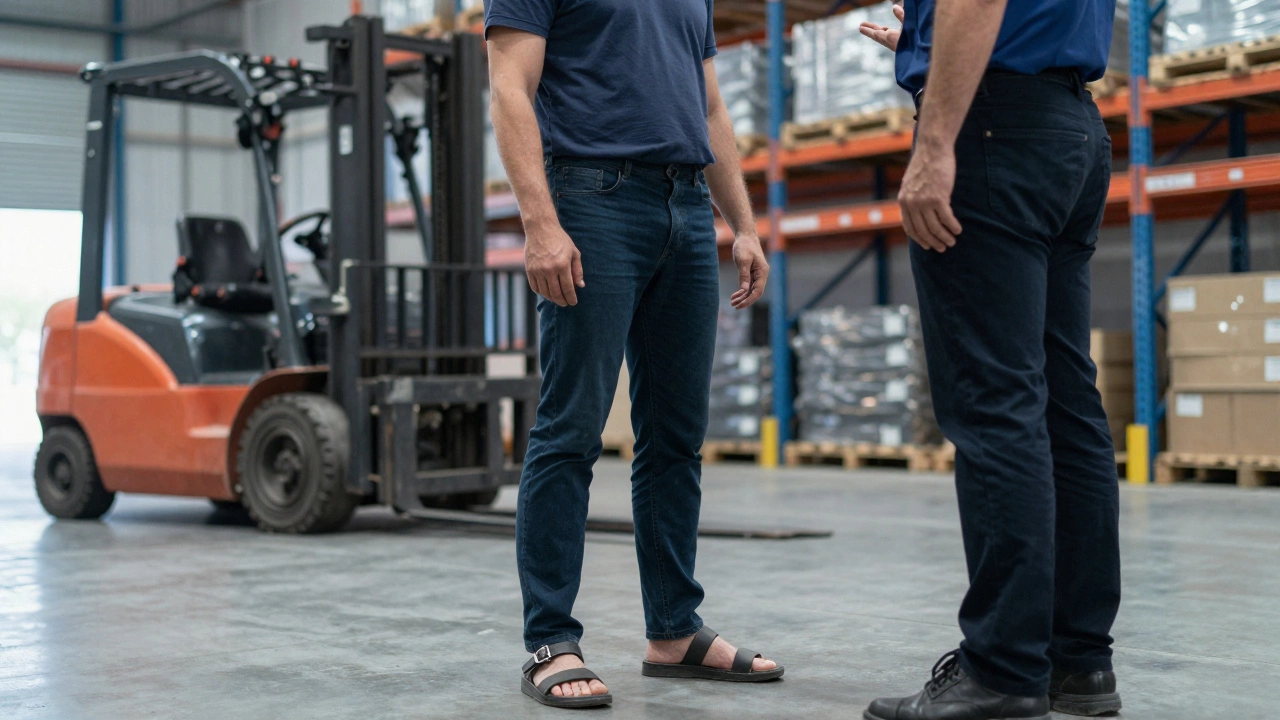
Think of it this way: if a forklift driver drops a pallet, a steel-toed boot might save your foot. An open-toed sandal will not. The hazard is real, the risk is severe, and the lack of protection is a direct violation of safety principles enforced by OSHA inspectors.
Specific OSHA Standards for Foot Protection
Beyond the broad General Duty Clause, OSHA has specific standards that mandate foot protection in certain industries. These are found in Title 29 of the Code of Federal Regulations (CFR).
| Standard Number | Industry/Context | Requirement |
|---|---|---|
| 29 CFR 1910.136 | General Industry | Employers must ensure each affected employee uses protective footwear when working in areas where there is a danger of foot injuries due to falling or rolling objects, or objects piercing the sole. |
| 29 CFR 1926.96 | Construction | Similar to general industry, requiring protective footwear when hazards are present. Often interpreted strictly regarding toe protection. |
| 29 CFR 1910.141 | Sanitation/Food Processing | While not always banning open toes, it often requires footwear that protects against contamination and slip hazards, which open toes rarely do. |
29 CFR 1910.136 is the most cited standard here. It states that employers must ensure employees use protective footwear when there is a danger of foot injuries. Note that it says "protective footwear." It does not define "protective" as only meaning steel-toe caps, but it certainly implies coverage. An open-toed shoe cannot protect against a falling object hitting the top of your foot, nor can it prevent debris from entering and injuring your skin. In a court of law or an OSHA hearing, arguing that an open-toed shoe is "protective" in a hazardous environment would fail.
When Are Open-Toed Shoes Allowed?
Not every workplace is a construction zone. There are scenarios where OSHA does not require protective footwear, and consequently, open-toed shoes may be permitted. However, "allowed" is different from "recommended."
- Office Environments: If you work in a cubicle, answering phones and typing reports, there are no recognized foot hazards. OSHA has no jurisdiction over your fashion choices here, provided your office has its own dress code policy.
- Low-Hazard Retail: Working in a clothing store where you are merely folding shirts and handling cash generally does not involve heavy impacts or puncture risks. However, even here, many stores enforce closed-toe policies for liability reasons.
- Administrative Roles in Industrial Sites: If you are an accountant who only visits the factory floor once a year for a meeting in a safe, designated area, you might not need full PPE. But if you walk through the production line, you likely do.
The key factor is the presence of hazards. If the only hazard is tripping over a rug, open-toed shoes might be technically compliant with OSHA, though still risky. If the hazard is a 50-pound gear shifting off a rack, they are not.
The Role of ANSI and ASTM Standards
OSHA sets the rules, but other organizations set the technical specifications for what makes a shoe "safe." When your boss asks for "safety shoes," they are usually referring to footwear that meets ANSI Z41 or the newer ASTM F2413 standards.
ASTM F2413 is the current standard for performance requirements for protective footwear. It tests shoes for:
- Impact Resistance: Can the toe cap withstand a 75-foot-pound impact?
- Compression Resistance: Can the toe cap withstand 2,500 pounds of compression?
- Puncture Resistance: Is there a midsole plate that prevents nails from piercing through?
Open-toed shoes, by definition, cannot meet the impact or compression standards for the toes because there is no toe box to test. They also typically lack the enclosed structure necessary for effective puncture resistance. Therefore, even if OSHA's language is sometimes debated, the technical standards referenced by safety professionals clearly exclude open-toed designs from being classified as "protective footwear" in hazardous zones.
Employer Policies vs. OSHA Law
A common point of confusion is the difference between federal law and company policy. OSHA sets the minimum standard. Employers can-and often do-set stricter rules. Even if OSHA might theoretically allow open-toed shoes in a very low-risk area, your employer has the right to prohibit them for insurance, liability, or cultural reasons.
If your employment contract or employee handbook states "closed-toe shoes required," violating that rule is grounds for termination, regardless of OSHA's stance. Furthermore, if you get injured while wearing prohibited footwear, your workers' compensation claim could be denied, or you could face reduced benefits due to negligence. Don't gamble with your income because you think you're technically within the gray area of federal law.
Common Misconceptions About Footwear Safety
Let's clear up some myths that lead to violations and injuries.
- "My shoes have rubber soles, so they're safe." A rubber sole helps with slips, but it does nothing for crushing injuries or chemical burns. Full coverage is needed for true protection.
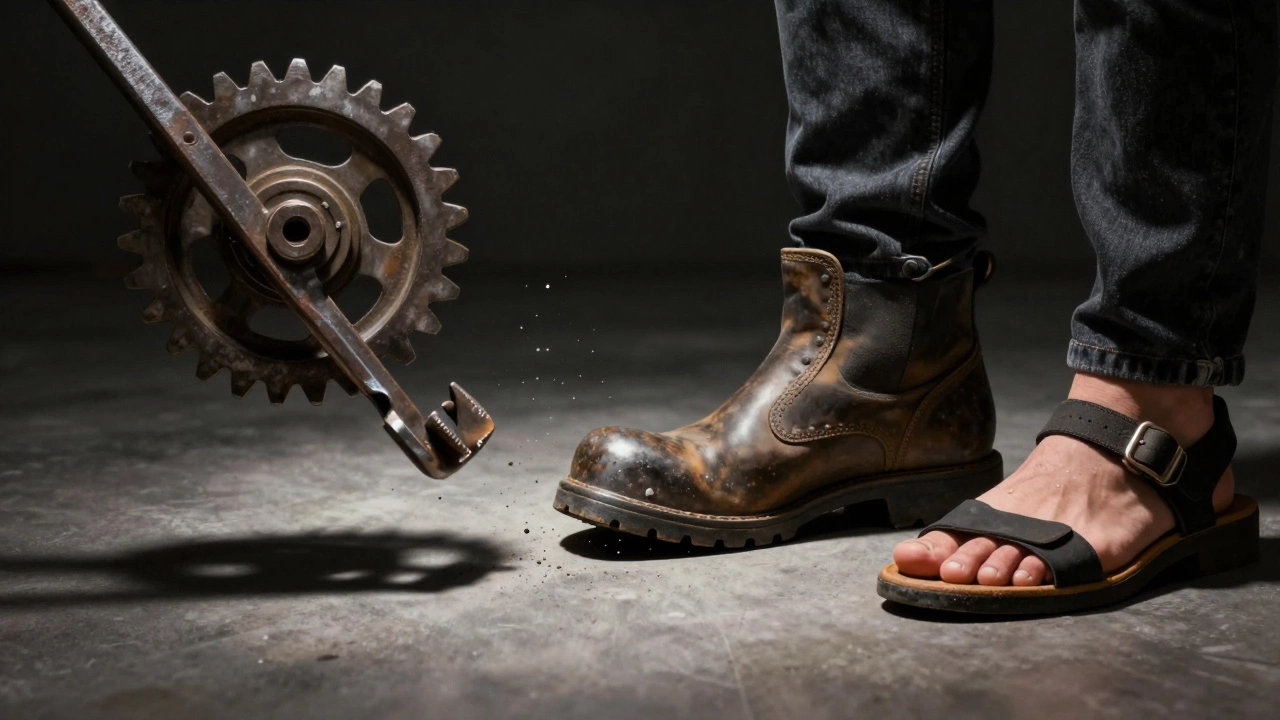
- "I've worn sandals here for years without getting hurt." Past luck is not future proof. One dropped wrench can end your career instantly. OSHA rules are based on potential risk, not historical accident rates alone.
- "Composite toes aren't real safety toes." False. Composite toes (made of fiberglass, plastic, or carbon fiber) meet the same ASTM F2413 standards as steel toes. They are lighter and non-conductive, making them excellent alternatives, especially in warm weather.
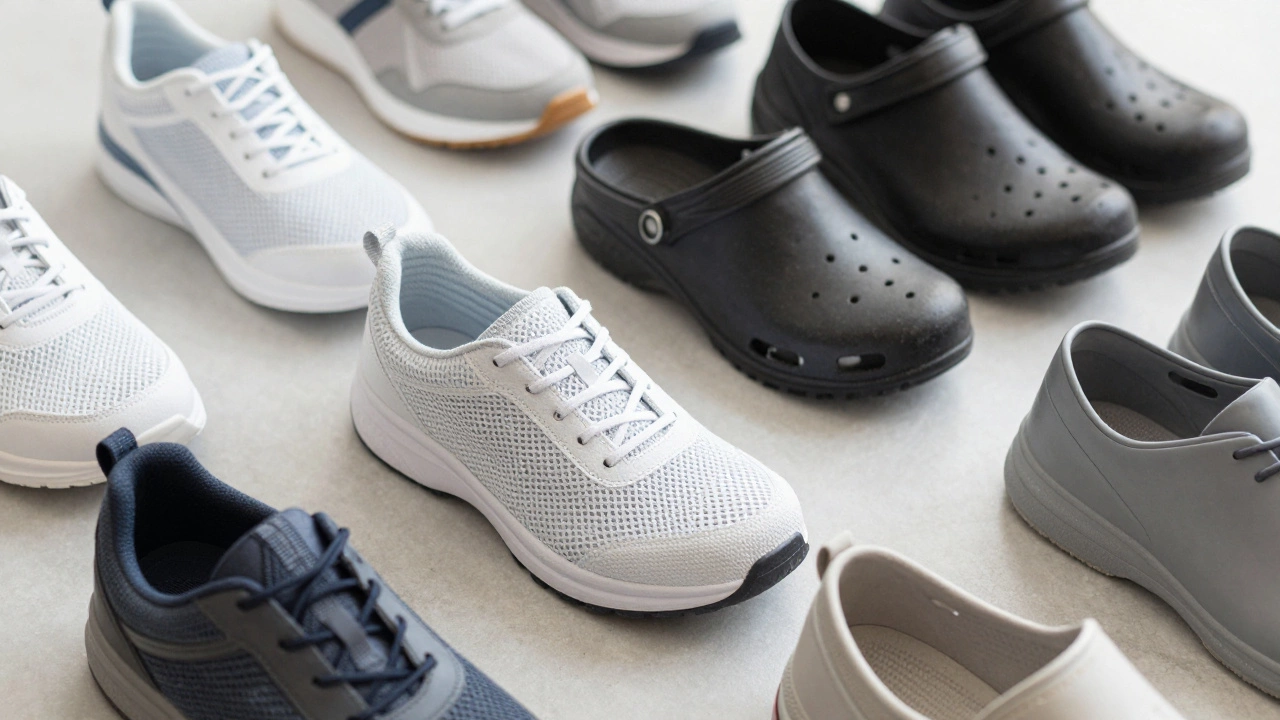
In fact, modern safety technology has made closed-toe shoes much more comfortable. Breathable mesh linings, moisture-wicking socks, and lightweight composite materials mean you don't have to suffer in heat to stay safe. Many brands now offer "dress-style" safety shoes that look like loafers but contain protective toe caps.
What Happens If You Get Cited?
If an OSHA inspector visits your site and sees workers in open-toed shoes in a hazardous area, they will issue a citation. This can result in significant fines for the employer. For the worker, the consequences are immediate:
- Removal from Work Area: You will be sent home or to a safe zone until you change shoes.
- Disciplinary Action: Verbal warnings, written reprimands, or termination depending on company policy.
- Liability Issues: If an injury occurs, the investigation will focus heavily on PPE compliance. Lack of proper footwear shifts blame onto the worker for failing to follow safety protocols.
Employers take this seriously because the financial penalty for an OSHA violation can range from hundreds to thousands of dollars per instance. They are motivated to enforce strict footwear policies to avoid these costs and, more importantly, to keep their workforce intact.
Choosing the Right Alternative
If you hate the idea of heavy, clunky boots, you have options. The goal is to find footwear that satisfies both OSHA/ASTM standards and your comfort needs.
- Safety Sneakers: Look for athletic-style shoes with ASTM-rated toe caps. They breathe better than leather boots.
- Clogs: Brands like Crocs make professional clogs with closed toes and slip-resistant soles, suitable for food service and healthcare.
- Mesh Safety Shoes: Designed for summer, these use breathable fabrics but maintain the structural integrity for toe protection.
Always check for the ASTM F2413 label inside the tongue of the shoe. If it's not there, it's not a safety shoe, no matter how thick the leather looks.
Does OSHA specifically mention "open-toed shoes" in their regulations?
No, OSHA does not explicitly use the phrase "open-toed shoes" in its statutes. However, they mandate "protective footwear" in hazardous environments under standards like 29 CFR 1910.136. Since open-toed shoes cannot provide adequate protection against impacts, compression, or punctures, they are considered non-compliant in those settings.
Can I wear sandals in an office environment?
Generally, yes. OSHA focuses on workplaces with recognized physical hazards. In a standard office setting with no heavy machinery or falling objects, there is no federal requirement for protective footwear. However, you must still adhere to your employer's internal dress code policy.
Are Crocs considered OSHA-compliant?
Only specific models. Standard open-back Crocs are not compliant in hazardous areas. However, Crocs offers "Work Collection" clogs that are closed-toe, closed-heel, and meet ASTM F2413-18 standards for impact and compression resistance. Always verify the specific model has the safety rating.
What is the penalty for wearing improper footwear?
For the employer, OSHA can issue fines ranging from $134 to $15,625 per violation (as of recent adjustments). For the employee, penalties include being removed from the work site, disciplinary action up to termination, and potential denial of workers' compensation claims if an injury occurs due to negligence.
Do I need steel-toe boots if I work in a warehouse?
If there is a risk of falling objects, rolling equipment, or heavy loads, yes. You need footwear rated for impact and compression. This doesn't have to be steel; composite or alloy toes are equally compliant with OSHA-referenced ASTM standards and are often lighter and more comfortable.