How to Tell How Old a Vintage Jacket Is
- Cleo Fairchild
- 22 December 2025
- 0 Comments
Vintage Jacket Dating Quiz
How would you identify this jacket's era based on its label?
"Made in USA" printed in blocky sans-serif font with bright colors on a woven label
What type of zipper would indicate a jacket is likely from the 1960s or earlier?
Brass-colored metal zipper with a teardrop-shaped pull tab
Which of these indicates a jacket is likely from the 1970s or 1980s?
Smooth polyester lining with a slightly shiny interior
What indicates a jacket is from the 1970s or later?
Care label with standardized symbols (circles, triangles, squares)
Which feature would be unusual on a jacket from the 1940s or 1950s?
Welted pockets (clean, flush with the fabric)
Finding a vintage jacket that looks amazing is one thing. Knowing how old it actually is? That’s where most people get stuck. You might pick up a leather bomber or a wool pea coat at a thrift store, admire the stitching, and wonder - is this from the 1970s? The 1990s? Or something older? The truth is, you don’t need a degree in fashion history to tell. You just need to know where to look - and what to look for.
Check the maker’s label
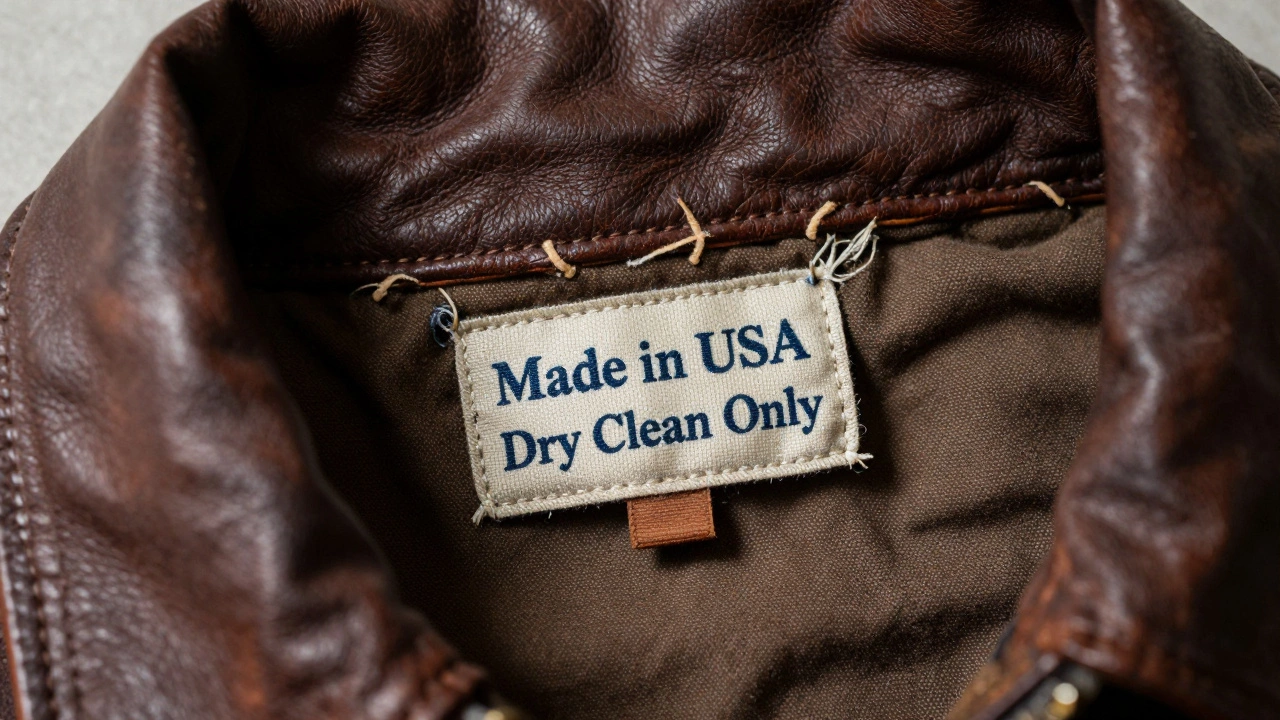
The label inside a jacket is your first and most reliable clue. Vintage labels changed dramatically over the decades, both in style and content. In the 1940s and 1950s, labels were often small, printed in serif fonts, and made of woven cotton or silk. They usually included the brand name, country of manufacture, and sometimes a care instruction like “Dry Clean Only.”By the 1970s, labels got bolder. You’ll see blocky sans-serif fonts, bright colors, and phrases like “Made in USA” or “Made in Japan.” The 1980s brought logos that looked like they were designed on a dot-matrix printer - think oversized, glossy, and sometimes even metallic. In the 1990s, many brands started using woven tags with the brand name in all caps, often stitched along the side seam instead of the center back.
One big red flag? If a jacket says “Made in China” and claims to be from before the 1980s, it’s likely a reproduction. China didn’t become a major exporter of apparel until the late 1970s, and even then, most Western brands kept production in the US, Canada, or Europe until the 1990s. If the label says “Made in West Germany,” you’re looking at something from before 1990.
Look at the zipper
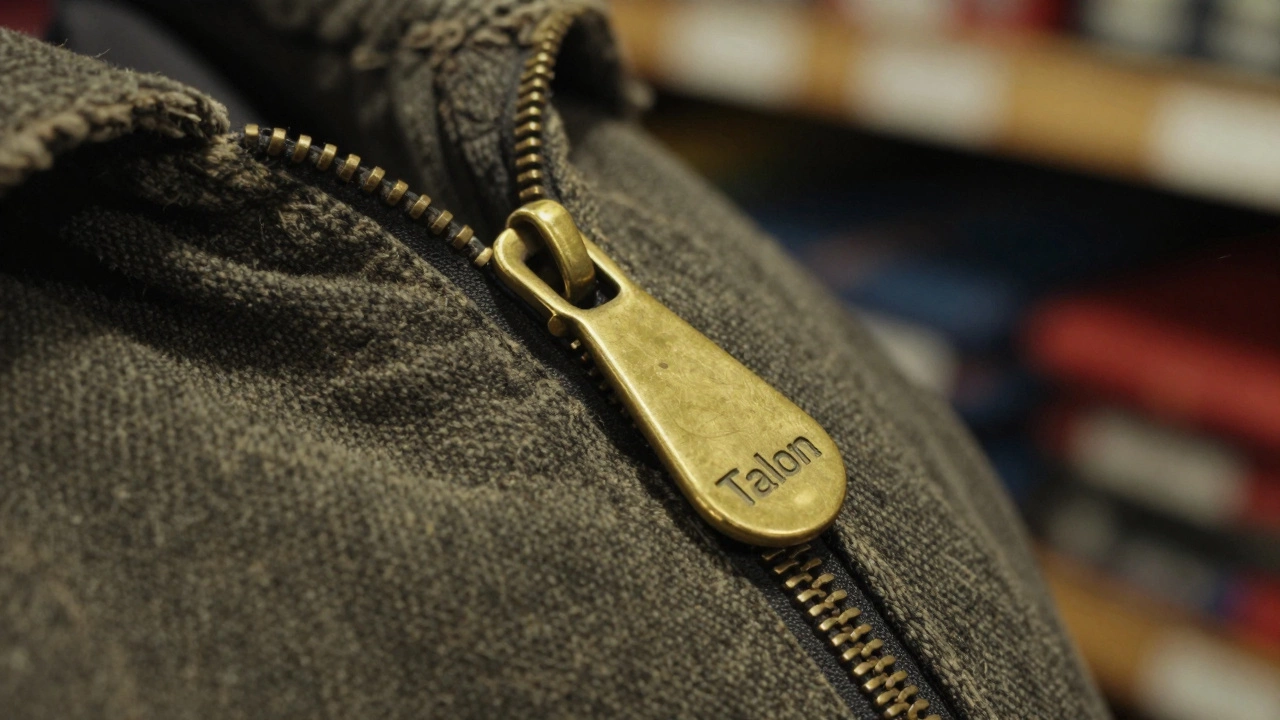
Zippers tell stories. Before the 1960s, most jackets used metal zippers, often with a pull tab shaped like a teardrop or a small ring. Brands like Talon and YKK were the main players, and you’ll find their names stamped right on the zipper pull. If the zipper is brass-colored and feels heavy, it’s likely pre-1970.Plastic zippers didn’t become common until the 1970s and 1980s. If your jacket has a smooth, lightweight plastic zipper with no visible brand name, it’s probably from that era. By the 1990s, YKK started using plastic zippers with a small “YKK” stamped on the slider - still visible if you look closely.
Here’s a quick trick: try pulling the zipper slowly. If it’s stiff and makes a clicking sound, it’s likely old metal. If it glides silently and feels flimsy, it’s probably plastic - and likely from the 1980s or later.
Examine the stitching and construction
Old jackets were built to last. You’ll notice thicker thread, more stitches per inch, and often double-stitched seams. Look at the inside of the jacket - if the seams are finished with a serger (a machine that trims and overlocks fabric in one pass), it’s probably from the 1980s or later. Before that, most garments were flat-felled or French-seamed, which means the raw edges are folded and stitched down neatly.Also, check the lining. Vintage jackets from the 1940s to the 1960s often had silk or rayon linings. By the 1970s, polyester became the norm. If the lining feels slick and synthetic, and the jacket has a slightly shiny interior, it’s likely from the 1970s or 1980s. If it’s soft, slightly wrinkled, and has a matte finish, it’s probably older.
Another detail? Buttonholes. On jackets made before 1970, buttonholes were often hand-stitched, especially on higher-end pieces. You’ll see tiny, even stitches forming a loop around the buttonhole. Machine-made buttonholes from the 1980s onward tend to be straight, uniform, and slightly wider.
Check the fabric and texture
Fabric tells you a lot. Wool from the 1950s and 1960s was often heavier, with a tighter weave. You’ll feel the density - it doesn’t stretch much and holds its shape. By the 1980s, wool blends became popular, mixing in acrylic or nylon to cut costs. That’s why you’ll see some 1980s jackets that look wool but feel a bit plastic-y or overly smooth.Leather jackets are easier. Real leather from the 1950s to 1970s tends to be softer, with a natural grain that varies across the surface. It ages with a patina - darkening in spots, softening over time. Fake leather from the 1980s and 1990s? It’s usually uniform, shiny, and cracks easily. If the jacket smells strongly of chemicals or plastic, it’s not vintage.
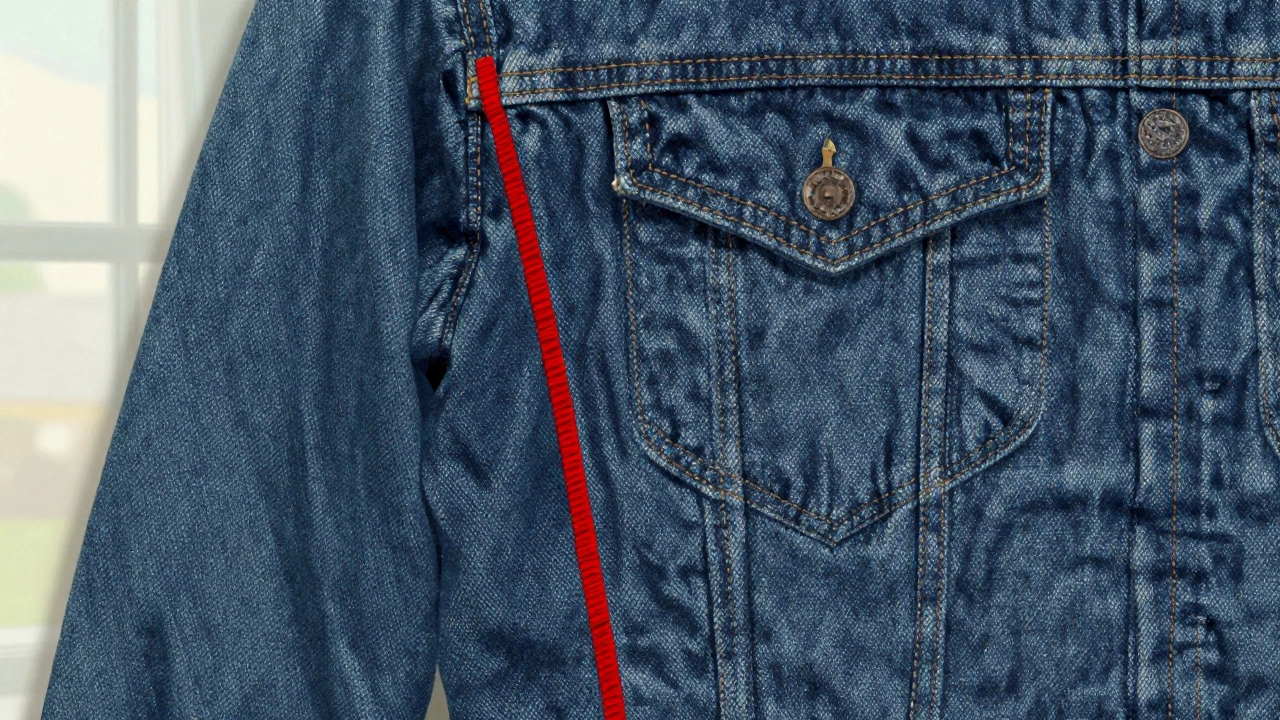
Denim jackets? Look at the selvage edge - the tightly woven edge along the side seam. If it has a colored thread running along it (often red or blue), it’s likely made on an old shuttle loom, which means it’s from before the 1980s. After that, most denim was made on wider, faster looms, and the selvage edge became plain or non-existent.
Look for style cues
Fashion doesn’t just repeat - it evolves in cycles, and each decade has its signature silhouette. A cropped, boxy jacket with wide lapels and shoulder pads? That’s 1980s. A long, slim-cut pea coat with a single button and no lining? Likely 1940s or 1950s. A bomber jacket with ribbed cuffs and waistband, made of nylon and lined with polyester? That’s 1970s or 1980s.Collars matter too. A stand-up collar with no lapels was common in the 1950s. In the 1960s, you started seeing notch lapels on blazers and trench coats. The 1990s brought oversized, slouchy fits - think flannel-lined denim jackets with huge hoods.
Even the pockets give it away. Patch pockets with visible stitching on the outside? Common in the 1940s-1960s. Welted pockets (clean, flush with the fabric)? More typical of the 1970s-1980s. And if you see a zippered pocket on the chest - especially on a denim jacket - that’s a 1980s or 1990s addition.
Use the care label as a timeline
The US government didn’t require care labels on clothing until 1971. So if your jacket has no care label at all, it’s likely from before then. If it has one, check the symbols. Pre-1990s labels used words like “Dry Clean” or “Wash in Cold Water.” After 1990, standardized symbols became mandatory - the little circles, triangles, and squares you see today.If you see a care label with a “Do Not Dry Clean” warning, it’s probably from the 1980s or later, when dry cleaning chemicals started being questioned for damaging natural fibers. That’s a clue most people miss.
Compare it to known examples
The best way to train your eye? Look at museum collections. The Metropolitan Museum of Art’s Costume Institute, the Victoria and Albert Museum in London, and even the Smithsonian have online archives of vintage garments with dates attached. Compare your jacket’s label, zipper, stitching, and shape to photos from the 1950s, 1970s, or 1990s. You’ll start noticing patterns.Also, search for the brand name online. If the brand went out of business in 1983, and your jacket has that label, you’re looking at something from before then. Brands like Levi’s, Schott, and Barbour have well-documented histories - their website archives or fan sites often show label changes year by year.
Don’t trust the seller’s claim
Too many vintage sellers say “1970s!” just to make the price higher. Always verify. A jacket with a 1990s zipper, polyester lining, and a care label? Doesn’t matter what the tag says - it’s not from the 1970s. Trust the details, not the story.And if the jacket smells like mothballs or has a strong chemical odor, it’s been stored poorly - but that doesn’t make it older. It just means it needs cleaning. Age isn’t about smell. It’s about construction.
What if you’re still unsure?
Take a photo of the label, zipper, and inside seam. Post it in a vintage fashion forum like Reddit’s r/vintagefashion or the Vintage Fashion Guild. People there have seen thousands of jackets. They’ll spot a 1960s YKK zipper or a 1950s silk lining in seconds.Or visit a local vintage dealer who’s been in business for 20+ years. They don’t need to guess - they’ve handled the same styles for decades. Ask them to explain why they think it’s from a certain era. If they can point to the stitching or the label, you’re getting real knowledge - not just a sales pitch.